Topic in, narrated Manim video out.
An Agent Skill that interviews you about the content, writes a beat-by-beat storyboard, narrates it, renders it with Manim, and QA-checks every beat — then keeps doing it in the same visual style for the whole series.
uvx manim-math-video-studio --platform claude
One agent at a time. Replace claude with codex, copilot, or pi. Needs Python 3.10+ and uv; installs the shared Manim environment. Other installers.
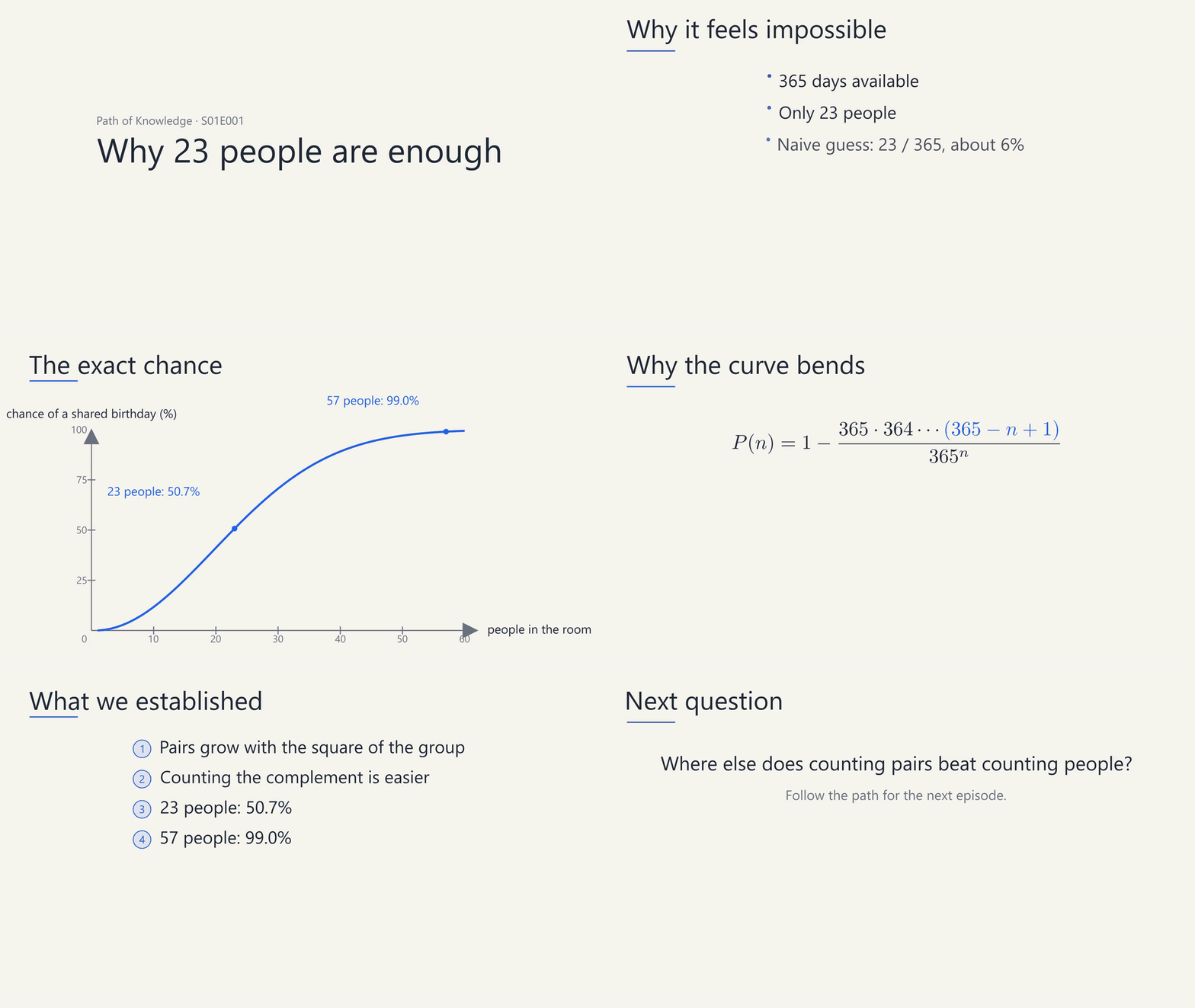
Why it is not just a prompt
Interview first
It asks about the content — central question, audience, crux, visual approach, takeaway — before writing a single line of scene code. A theme is not a brief.
Narration drives the clock
Each beat gets a measured TTS duration, and the animation follows it. Nothing is ever cut off mid-sentence, and subtitles stay in sync.
Built for series
A series registry keeps template, palette, typography, and narration identity stable, so episode 12 still looks like episode 1.
Verified, not vibes
JSON-schema validation for the brief and storyboard, an environment check, contact-sheet QA, and a self-test.
Any subject
History, science, technology, literature, philosophy, art, tutorials — mathematics is one supported domain, not the whole product.
Portable skill
One skill tree, four frontmatter variants: Claude Code, Codex, GitHub Copilot, and Pi. Same workflow, same references, same scripts.
The pipeline
- Interview — content, audience, crux, visuals, takeaway →
brief.json - Lock — quality, voice, language, template (the only four parameters that need deciding up front)
- Storyboard — beats, timings, graph specs, captions →
storyboard.json - Narrate — edge-tts, Piper, or your own command → audio + per-beat timings + SRT/VTT
- Render & QA — Manim, then a contact sheet per beat so you can review without scrubbing
Voice providers
Edge-tts is the free default. Cartesia and ElevenLabs are native providers when their API keys are available. Voice choice is explicit: generate samples, check access and language, then keep the same voice across the series.
edge-tts
Free default with word boundaries for captions, broad language coverage, and curated voices. No key required.
Cartesia
Native adapter with WAV output, speed/volume control, and live voice listing. Needs CARTESIA_API_KEY; check the access and language columns before choosing.
ElevenLabs
Native adapter with multilingual models and voice settings. Needs ELEVENLABS_API_KEY; library voices require a paid plan, so prefer an owned voice.
Install one agent at a time
| Agent | Install | Invoke |
|---|---|---|
| Claude Code | uvx manim-math-video-studio --platform claude | /manim-math-video |
| Codex | uvx manim-math-video-studio --platform codex | $manim-math-video |
| GitHub Copilot | uvx manim-math-video-studio --platform copilot | /manim-math-video |
| Pi | uvx manim-math-video-studio --platform pi | /skill:manim-math-video |
The package installs the skill and the shared environment. Prefer pipx or a checkout? See the install guide.